
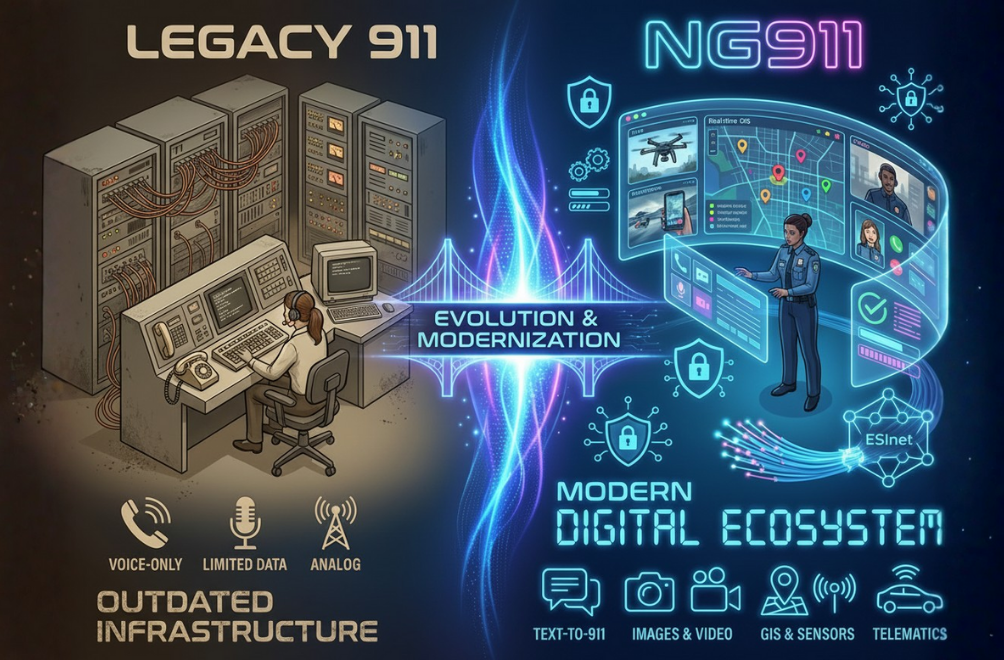
For more than 50 years, 911 networks have served as the foundation of public safety communications. But much of the legacy 911 infrastructure was built for a world where voice calls over T1 lines were the norm. These systems were dependable for their time, yet increasingly misaligned with how people communicate today—through text, images, video, apps, and connected devices.
To meet these modern expectations, jurisdictions across North America are transitioning to Next Generation 911 (NG911), a digital, IP-based ecosystem built for richer, faster, and more resilient emergency communication.
What NG911 Is—and Why It Matters
NG911 replaces traditional circuit-switched networks with an Emergency Services IP Network (ESInet)—a secure, engineered, and highly resilient IP backbone designed specifically for emergency services. This shift enables PSAPs to receive more than just voice calls. With NG911, emergency centers can process:
- Text-to-911
- Images and video
- GIS-based location
- Telematics and sensor data
- Improved interoperability between PSAPs
In short, NG911 brings emergency communications into alignment with the digital world citizens already live in.
From T1 Lines to ESInet: A Necessary Evolution
Legacy 911 relies heavily on T1 lines—fixed-capacity circuits optimized for voice traffic. While reliable, they come with real limitations:
- Restricted bandwidth
- No support for multimedia
- Difficult, hardware-heavy scaling
- Limited flexibility for routing and redundancy
ESInet-based NG911 overcomes these gaps by leveraging broadband IP networks. This creates a more flexible, scalable, and future-ready environment for emergency services—one capable of delivering richer information to call-takers and, ultimately, first responders.
Challenges PSAPs Face on the NG911 Journey
Although NG911 offers major benefits, migrating to it is a complex, multi-year effort. PSAPs typically encounter a combination of technical, operational, and governance challenges.
- Multi-Vendor Coordination
NG911 implementations span a diverse vendor landscape—ESInet providers, NG911 Core Services, CAD vendors, GIS systems, recording platforms, cybersecurity tools, and multiple telecom carriers. Coordinating these players toward a coherent, interoperable environment requires structured oversight.
- Standards and Interoperability
NG911 is based on evolving standards (e.g., NENA i3, NG911 GIS requirements). Ensuring vendors truly meet these standards—and that systems work across jurisdictions—is essential but often difficult for PSAPs to validate.
- Network and Cybersecurity Requirements
IP-based systems introduce new cybersecurity expectations:
- Resilient network paths
- DDoS protection
- Segmented architectures
- Continuous monitoring
PSAPs must adopt a stronger security posture to protect mission-critical services.
- Extensive Testing With Telcos and Partners
Before going live, NG911 environments must undergo rigorous tests:
- End-to-end routing
- Location accuracy and GIS-based call flows
- Text-to-911
- Multimedia handling
- Failover and disaster recovery
These testing cycles can be intricate and require close collaboration with carriers and vendors.
- Operational Change Management
NG911 impacts more than technology. It changes:
- Call-taking workflows
- Mapping and location processes
- Supervisor oversight
- SOPs and QA practices
Training and readiness planning become essential to ensure a smooth transition.
- Funding and Phased Implementation
NG911 migrations are typically phased over several years, often involving multiple agencies and funding sources. Clear governance, cost forecasting, and milestone planning are critical for success.
How We Support PSAPs Throughout the NG911 Lifecycle
We help PSAPs move confidently through the complexities of NG911 modernization. Our support spans the full lifecycle—from strategic planning to deployment and stabilization.
✔ Readiness Assessments & Roadmapping
We help PSAPs evaluate their current environment, identify capability gaps, and build a practical, phased NG911 migration plan tailored to operational realities.
✔ RFP Development & Vendor Selection
We assist with:
- Drafting clear, standards-based RFPs
- Embedding technical, functional, and integration requirements
- Evaluating and scoring vendor proposals
- Supporting demos and proof-of-concepts
Our goal is to help agencies make informed, risk-aware vendor choices.
✔ Project & Program Management
We provide structured governance, milestone tracking, risk management, and cross-vendor coordination—ensuring all technology, carrier, and operational partners stay aligned.
✔ Integration, Testing & Telco Coordination
We can support PSAPs with lab testing, carrier routing tests, GIS validation, failover scenarios, and end-to-end NG911 readiness checks.
✔ Commissioning & Go-Live Support
We ensure controlled, low-risk transitions with detailed runbooks, oversight during cutover, and on-the-ground support.
✔ Post-Go-Live Stabilization
Once NG911 is live, we help refine SOPs, tune configurations, support staff adaptation, and plan future phases.
Moving Toward the Future of Public Safety
NG911 is more than a technology upgrade—it is a foundational shift in how emergency communications will operate for decades to come. While the transition is complex, the outcome is a safer, more connected, and more resilient public safety ecosystem.
We are here to guide PSAPs every step of the way—from planning and procurement to testing, commissioning, and ongoing support.
If you are preparing for NG911 or reassessing your roadmap, we would be glad to partner with you.
Contact us at admin@ikitesconsulting.ca to begin the conversation.